Are Driving Lessons in a 2026 Toyota Camry Right for You?
Last Updated: October 26, 2026
Quick Summary
Driving lessons 2026 Toyota Camry offer new drivers a reliable, predictable learning environment with excellent visibility, responsive handling, and comprehensive safety features like automatic emergency braking and lane departure warning. The Camry's standardized controls and stable dynamics build confidence and muscle memory that transfer to most vehicles you'll encounter later.
The 2026 Camry is sold exclusively with a hybrid powertrain, so learners should understand regenerative braking and quiet electric motor operation before their first lesson.
Six-stage progression covers cockpit setup, low-speed control, steering and turns, traffic and intersections, highway driving, and parking maneuvers.
Ask your instructor about credentials, teaching structure, video review options, and whether they administer the official road test before committing.
Practice regenerative braking in an empty lot by lifting off the accelerator and feeling the car slow on its own before adding brake pressure.
Pfister Auto Academy combines 30 hours of online coursework with personalized behind-the-wheel training and handles pickup, dropoff, and road test administration.
Table of Contents
Why the 2026 Toyota Camry Works for Driving Lessons
Choosing the right vehicle for driving lessons 2026 Toyota Camry matters more than most new drivers realize. Finding a safe driving school is equally important to ensure quality instruction in that vehicle.
At Pfister Auto Academy, we've selected the 2026 Toyota Camry because it balances responsive handling with forgiving dynamics. Moderate acceleration teaches smooth throttle control, braking provides consistent feedback, and visibility is excellent, crucial when you're still judging distances and traffic flow.
The Camry's size works in your favor too: stable on the highway, nimble enough for parking and tight turns. First-time drivers feel more confident in a vehicle whose boundaries they can sense. Building confidence behind the wheel is a key part of the learning process in any vehicle.
For road-test preparation, the 2026 Camry represents what most examiners expect: a well-maintained, standard-layout sedan with no distracting gimmicks. You'll build muscle memory that transfers to the vehicles most people actually drive.
Understanding the Driving School Training Car You'll Use
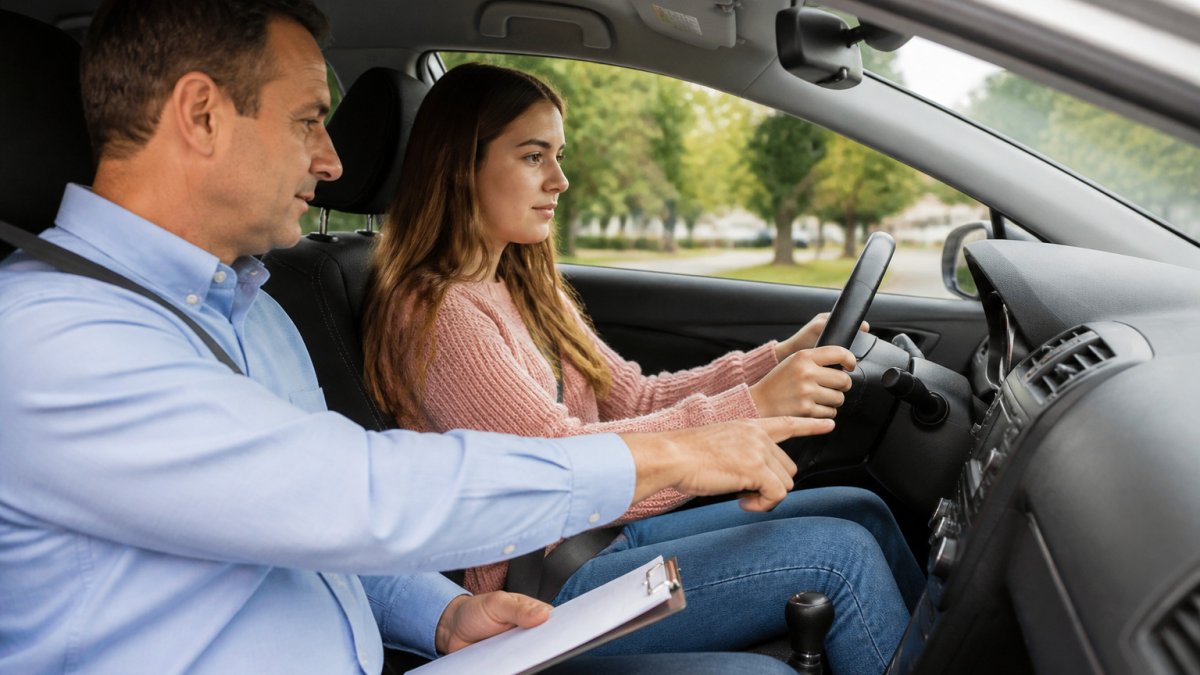
Your driving school training car shapes your entire learning experience. The 2026 Toyota Camry provides a strong foundation for effective behind-the-wheel driving lessons.

The dashboard layout is clean and intuitive: turn signal on the left, wipers on the right, gear shift in the center console. This standardized setup builds habits that work in most vehicles you'll encounter later.
Visibility is exceptional: large windows, well-positioned mirrors, and minimal blind spots reduce the anxiety of feeling "blind" to traffic. Steering is responsive but not twitchy, clear feedback about the front wheels without overreacting to small inputs. The brake pedal offers good modulation, letting you feel the difference between gentle deceleration and hard stopping.
Toyota Camry Safety Features That Protect New Drivers
Safety features in the 2026 Toyota Camry create a protective envelope while you learn. They aren't substitutes for good habits, but they reduce the consequences of beginner mistakes.
Stability Control and Traction Management
Electronic stability control automatically corrects skids before they become dangerous.
Comprehensive Airbag System
Multiple airbags protect occupants in frontal, side, and rollover impacts, letting you focus on learning rather than catastrophizing every potential accident.
Backup Camera and Parking Assist
The backup camera displays what's behind you on the center screen, removing guesswork from reversing, where many new drivers feel most vulnerable. Parking assist provides audio cues if you drift toward obstacles.
Automatic Emergency Braking
Forward collision warning alerts you if you're closing on a vehicle ahead too quickly, and the system can brake automatically, a safety net for momentary lapses, not a substitute for attention.
Lane Departure Warning
If you drift out of your lane unintentionally, the system alerts you, catching tired moments or brief distractions before they become dangerous.
Together these features create a forgiving learning environment, reducing the penalty for the small mistakes inevitable when you're learning.
What to Ask Your Driving Instructor Questions Before Starting
The quality of your driving lessons depends heavily on your instructor. Before you commit, ask the right questions.
Experience and Credentials
Ask how long your instructor has been teaching and about their credentials. At Pfister Auto Academy, our instructors are licensed master educators with extensive experience.
Teaching Approach
Ask how they structure lessons. Do they follow a progression from basic vehicle control to highway driving to road test preparation, or wing it? A structured approach builds skills in logical order. Ask if they use video review.
Road Test Preparation
Ask directly: Will you teach me to pass the test, or to be a safe driver? The best answer is both, but you want an instructor focused on genuine safety skills, not test-taking tricks. Ask if the instructor administers the official road test or just prepares you.
Communication with Parents
If you're under 18, ask how your instructor communicates progress to your parents, regular updates, lesson observation? Good instructors welcome parental involvement because it reinforces learning at home.
Behind-the-Wheel Driving Lessons: Structure and Practice
A good lesson plan progresses from vehicle control to traffic to test preparation, but the details matter more than the stage names. Learning defensive driving techniques deepens the skills practiced at each stage.
Stage 1: Cockpit setup and vehicle familiarization
Before the car moves, your instructor should walk you through the Camry's controls.
Seat and mirror setup comes next.
Stage 2: Starting, stopping, and low-speed control
Next, practice creeping: moving the car at walking pace using only the brake pedal to control speed, with no accelerator input.
Stage 3: Steering, turns, and lane positioning
Move to a quiet residential area or a large lot with painted lines.
Stage 4: Traffic, intersections, and lane changes
On moderate roads, practice the full sequence at intersections: mirror check, signal, brake, stop or yield, then proceed when clear.
This is also where the Camry's driver-assistance settings matter.
Stage 5: Highway driving
Highway lessons focus on merging, maintaining steady speed, following distance, and lane discipline.
Stage 6: Parking and road-test maneuvers
Practice parallel parking, three-point turns, and pulling into and out of a perpendicular parking space.
Watch Out A standard 2026 Camry is a suitable practice and test vehicle, but it does not have instructor brake pedals. Supervised practice in a standard car depends on the instructor's ability to reach the controls from the passenger seat, which varies by vehicle and by the instructor's setup. Ask your school directly whether its training cars are equipped with dual controls, and do not assume a standard sedan is set up for instructor intervention.
What to ask before your first behind-the-wheel lesson
Which stages will be covered in the first lesson, and how many lessons does each stage typically take?
Is the training car a standard Camry or one equipped with instructor controls?
Will the instructor demonstrate the hybrid start sequence and regenerative braking before you drive?
How will progress be tracked between lessons?
A structured progression, practiced in the specific car you will test in, is what turns lessons into skills.
Driving lessons progress through six stages, each building specific skills in the 2026 Toyota Camry.
Stage | Focus | Key Practice |
1 | Cockpit setup and familiarization | Mirror and seat adjustment, control location |
2 | Starting, stopping, low-speed control | Smooth pull-aways, consistent stops, creeping |
3 | Steering, turns, lane positioning | Gentle turns, lane discipline, turn signals |
4 | Traffic, intersections, lane changes | Mirror checks, signaling, shoulder checks |
5 | Highway driving | Merging, following distance, fatigue awareness |
6 | Parking and road-test maneuvers | Parallel parking, three-point turns, reversing |
Hybrid Driving Behavior and Fuel Efficiency for New Drivers
The 2026 Toyota Camry is sold exclusively with a hybrid powertrain, so if you are learning in a new Camry, you are learning in a hybrid.
What the hybrid system actually does
The Camry pairs a gasoline engine with an electric motor and a battery pack.
Quiet startup and pull-away
When you press the start button, the Camry may not produce a traditional starter sound. The instrument cluster lights up and a "READY" indicator confirms the vehicle is on.
Regenerative braking, explained for a new driver
When you lift off the accelerator or press the brake pedal lightly, the electric motor switches to generator mode and sends energy back to the battery.
A useful practice exercise: in an empty parking lot, accelerate to about 10 mph, lift your foot completely off the accelerator, and let the car slow on its own. Notice how far it travels before you need the brake. Repeat, this time adding light brake pressure to stop smoothly at a marked point. Do this five or six times. New drivers who practice this early tend to develop smoother braking because they stop treating the brake as an on-off switch.
Pro Tip Ask your instructor to demonstrate the difference between lifting off the accelerator and pressing the brake in a safe, empty lot. Feeling the two forms of deceleration side by side is the fastest way to understand regenerative braking.
Smooth acceleration matters more in a hybrid
Because the electric motor provides instant torque at low speed, a heavy right foot in a Camry can produce a stronger launch than a beginner expects.
Fuel efficiency, described honestly
Hybrids are most efficient in city and stop-and-go driving because the electric motor handles the low-speed work where a conventional engine is least efficient.
What to practice before your first road lesson
Start the car and confirm the READY indicator without pressing the button twice.
Pull away from a stop with steady, gradual throttle and note when the engine starts.
Lift off the accelerator at low speed and feel the car slow on its own.
Practice light, progressive brake pressure to stop at a marked point.
Locate the fuel economy readout and check it after each exercise.
None of this replaces supervised instruction.
Starting Your Lessons with Pfister Auto Academy
When you're ready to begin driving lessons 2026 Toyota Camry, the process should be straightforward and stress-free.
Indiana BMV requirements for teen driver licensing establish the foundation for any driver education program.
Our program combines 30 hours of online coursework with personalized behind-the-wheel training. The online portion covers traffic laws, hazard recognition, and decision-making.
Your behind-the-wheel lessons are customized based on your online performance and your individual learning style. Some students need extra time on highway driving.
We handle the logistics that make driver education stressful for families. We pick you up and drop you off at your home.
American Automobile Association resources on teen driver safety emphasize the importance of professional instruction and supervised practice. That's exactly what we provide.
You can book a driving lesson with Pfister Auto Academy to get started.
The 2026 Toyota Camry, paired with structured instruction and professional guidance, gives you the foundation for becoming a safe, confident driver.
Frequently Asked Questions
Is the 2026 Toyota Camry a good car for driving lessons?
Yes. The 2026 Camry is a midsize sedan designed for stability and visibility, both critical for new drivers. Its responsive steering, moderate acceleration, and predictable braking help learners build confidence. The sedan's moderate size makes parking and lane changes manageable for beginners, and its safety features provide additional protection during supervised lessons. Many driving schools choose this model because it performs consistently across varied road conditions.
What should I ask a driving instructor before booking behind-the-wheel driving lessons?
Ask about the instructor's experience and certifications, the vehicle's safety features, how lessons are structured based on your online course performance, whether the instructor provides feedback through video review (like hat camera footage), and what happens if you need additional lessons beyond the standard program. Also clarify whether the official driving test is included and whether the instructor offers door-to-door pickup and drop-off service.
How many behind-the-wheel lessons does a new driver typically need?
Most new drivers benefit from 6 to 10 hours of professional behind-the-wheel instruction, though this varies based on individual progress. Your lessons should cover city driving, highway navigation, parking, lane changes, defensive techniques, and road-test preparation. A master educator tailors lesson count to your performance in the online course and your comfort level, ensuring you're genuinely ready for the driving test rather than just passing it.
What features in a Toyota Camry can help new drivers feel safer?
Good visibility from the driver's seat, responsive power steering, and smooth regenerative braking (on the hybrid model) help new drivers maintain control. These features work alongside your instructor's guidance to build safe driving habits while providing a safety net during the learning process.
Learning to drive is a significant milestone. You deserve instruction that takes the process seriously, not a quick cash transaction, but a partnership focused on your safety and long-term driving success. That's what we deliver at Pfister Auto Academy.
Log In
Add pfisterautoacademy.com as a preferred source on Google →


Comments