Finding Safe Driving School for Teens: 2026 Guide
Table of Contents
What Makes a Driving School Safe for Teens
Driving School Safety Checklist: What to Verify Before Enrolling
State Certification and Licensing Requirements
Vehicle Maintenance and Safety Features
Insurance Coverage and Liability Protection
Driving Instructor Qualifications: Questions to Ask Before You Commit
How to Compare Instructor Quality Across Schools
Red Flags in Instructor Qualifications
Behind-the-Wheel Training for Teens: What Effective Instruction Looks Like
Evaluating Driving Instructor Qualifications and Experience
Classroom vs. Online vs. Hybrid: Comparing Training Formats
Red Flags: What to Avoid When Choosing a Driving School
Frequently Asked Questions
Last Updated: October 19, 2026
What Makes a Driving School Safe for Teens
Finding safe driving school for teens requires looking beyond marketing claims. Safety record, instructor qualifications, and vehicle maintenance determine whether your teen develops genuine skills or merely passes a test.
Safety starts with accountability: a reputable school keeps transparent records on instructor certifications, vehicle inspections, and student outcomes.
At Pfister Auto Academy, our instructors hold master educator certifications with over 20 years of experience, and our modern, well-maintained vehicles have dual controls.
The best driving schools teach teens to be safe drivers, not just to pass the test. A school focused only on test passage may skip defensive driving and hazard recognition skills that prevent accidents.
Key Takeaway A safe driving school invests in qualified instructors, maintains vehicles to high standards, and teaches defensive driving skills alongside test preparation.
Driving School Safety Checklist: What to Verify Before Enrolling
Before committing to any driving school, verify these safety factors. Use this checklist as a script: ask each question, request the document, and note the response.
State Certification and Licensing Requirements
Verify that your school holds current state approval and that all instructors carry valid licenses. Requirements vary by state, so check your state DMV website for specific criteria.
Ask directly: "Can you provide proof of your state certification?" A legitimate school answers immediately and explains what the certification covers and when it expires.
Licensed instructors must pass background checks and maintain clean driving records. A school that can't produce current licensing documentation is a red flag.
How to verify state approval in practice:
Find the official list. Most state DMVs publish a searchable list or PDF of approved driving schools. Search for your state's "approved driving school list" or "licensed driving school lookup." If none exists, call the DMV's driver education division for the current list.
Match the legal name. Schools sometimes market under a brand name that differs from their licensed entity. Ask for the exact legal name and license number, then confirm both appear on the state list.
Check instructor licenses individually. In many states, instructors must hold a separate instructor license or permit. Ask for each instructor's license number and confirm it is active, not expired or suspended.
Confirm the course counts toward licensing. A school can be licensed but its course may not satisfy your state's teen driver education requirement. Ask: "Does this course meet the state's requirements for a learner's permit or provisional license?" Get the answer in writing.
Verify expiration dates. State approvals and instructor licenses expire. Ask when the school's approval and each instructor's license were last renewed. A school that cannot state the renewal date may be operating on a lapsed approval.
State DMV approved driving school lookup
Vehicle Maintenance and Safety Features
The car your teen drives matters. Modern vehicles provide better feedback and safety systems.
Ask about the fleet: vehicle age, last inspection, and safety features. Dual controls are essential; anti-lock brakes, electronic stability control, and backup cameras all contribute to safer learning.
Request to see the vehicle before your first lesson. Worn tires, cracked windshields, or interior damage suggest neglected upkeep.
What to inspect on the training vehicle:
Tire tread depth. Ask the school to show you the tires.
Dual-control pedals. Confirm the passenger-side brake pedal is present and functional. Ask the instructor to demonstrate it before the lesson begins.
Dashboard warning lights. With the ignition on but the engine not running, all warning lights should illuminate briefly. If the check engine, ABS, or tire pressure light stays on, ask why.
Inspection sticker or record. Many states require periodic vehicle safety inspections. Ask to see the current inspection sticker or the school's maintenance log for that vehicle.
Cleanliness and visibility. A clean windshield, working wipers, and clear mirrors are basic. A dirty or cluttered interior suggests the school does not prioritize the learning environment.
Insurance Coverage and Liability Protection
Accidents happen during driver training, so know how liability is handled. Does the school carry comprehensive insurance, and are you protected if an accident occurs during your teen's lesson?
Ask for the school's insurance information in writing and verify liability coverage protects both student and instructor. Some schools require students to carry additional insurance; others include it in their fees.
Never enroll without understanding the liability structure.
Questions to ask about insurance:
What is the policy limit? Ask for the liability coverage limit per accident. A school that cannot state a number is a risk.
Does the policy cover student drivers? Confirm that the school's commercial policy covers a learner driver operating the vehicle under instruction. Some policies exclude students.
What happens if my teen is in an accident? Ask who pays the deductible, whether your personal auto policy would be involved, and whether the school's policy is primary.
Is there a written certificate of insurance? A legitimate school can provide a certificate of insurance naming the policyholder and coverage limits. Request it before the first lesson.
Watch Out Schools that are vague about insurance coverage or refuse to provide documentation are operating outside standard safety practices. This is a reason to choose another provider.
Key Takeaway A safe driving school can prove its state approval, instructor licenses, vehicle inspection records, and insurance coverage in writing. If any of these documents is missing or evasive, keep looking.
Driving Instructor Qualifications: Questions to Ask Before You Commit
The instructor makes or breaks the learning experience. A qualified instructor teaches defensive driving, recognizes when a teen is struggling, and adjusts instruction accordingly.
Before booking, ask these specific questions, and know what a strong answer sounds like.
How long have you been teaching? An instructor with experience understands teen learning patterns and has encountered diverse driving scenarios.
How do you handle nervous students? A good instructor recognizes anxiety and adjusts with encouragement, clear explanations, and gradual progression, never rushing or pressuring.
What's your approach to teaching defensive driving? Defensive driving teaches hazard recognition, risk assessment, and proactive decision-making, anticipating danger, not just following rules.
Can you provide references or student feedback? Legitimate instructors have satisfied students willing to vouch for them.
How to Compare Instructor Quality Across Schools
Because instructor quality varies widely, use a simple scoring framework when you talk to two or three schools. Rate each answer on a 1-3 scale (1 = vague, 3 = specific and documented) and compare totals.
Criterion | What a strong answer includes | Score (1-3) |
State instructor license | License number provided and verifiable |
|
Teen teaching experience | Specific number of years and students taught |
|
Defensive driving approach | Named techniques or lesson structure |
|
Handling nervous learners | A concrete example from experience |
|
Student references or feedback | Contactable references or summarized reviews |
|
Continuing education | Recent training or updated certifications |
|
Red Flags in Instructor Qualifications
No license number available. If the school cannot provide an instructor's state license number, treat it as unlicensed until proven otherwise.
Experience described only in vague terms. "Many years" without a number is a soft answer. Ask for a specific count.
No examples of teaching anxious teens. Teen anxiety is common; an instructor who cannot describe handling it may lack teen-specific experience.
Defensive driving mentioned only as a slogan. If the instructor cannot describe how a lesson teaches hazard recognition, defensive driving is marketing, not curriculum.
No continuing education. Traffic laws and vehicle technology change. An instructor who has not updated training in years may be teaching outdated habits.
Pro Tip Ask for a short phone or video call with the instructor before booking. A 10-minute conversation reveals more about teaching style and patience than any brochure.
Pfister Auto Academy's instructors hold master educator certifications and bring extensive real-world driving experience to every lesson.
Behind-the-Wheel Training for Teens: What Effective Instruction Looks Like
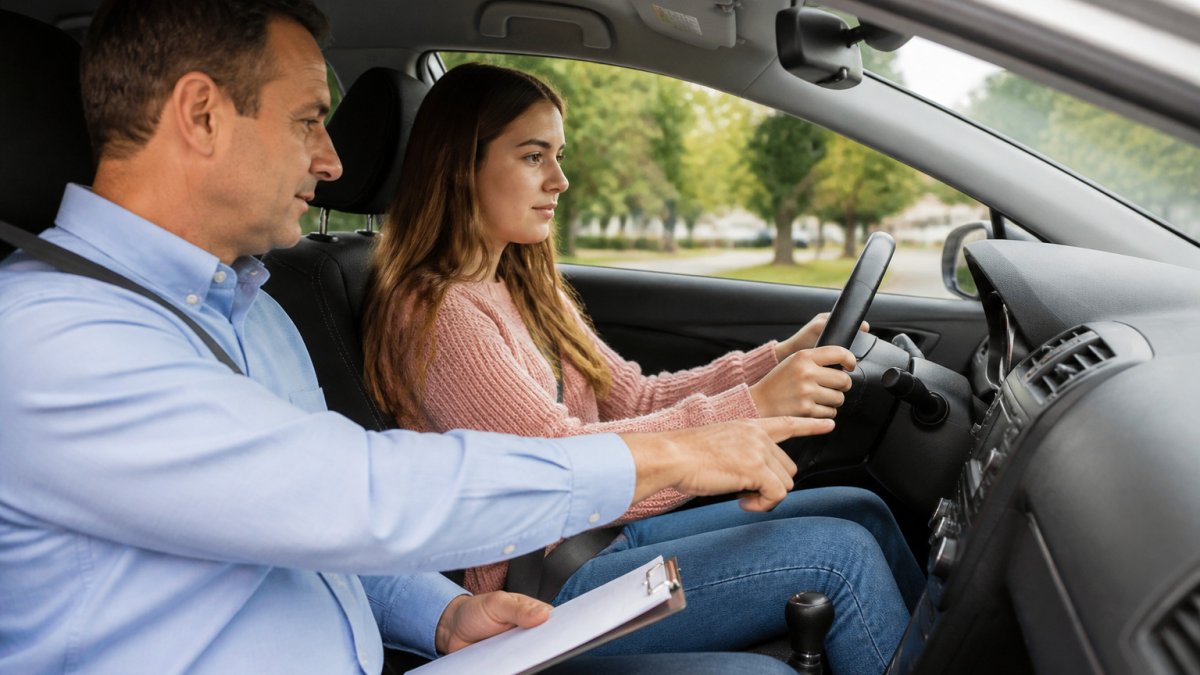
Behind-the-wheel training transforms theory into practical skill. Effective instruction follows a structured progression, from basic vehicle control in low-stress environments to complex driving scenarios.

As confidence builds, instruction progresses to busier roads, intersections, and highways.
Effective instruction includes hazard recognition. The instructor points out dangers, "See that parked car? Someone might open the door suddenly. Keep your distance", until teens spot hazards independently.
Behind-the-wheel training should include emergency maneuvers, sudden braking, skid recovery, in controlled conditions before real emergencies arise.
At Pfister Auto Academy, we use data-driven instruction. After the online theoretical course, we analyze your teen's performance to identify knowledge gaps. We tailor behind-the-wheel lessons to address those specific areas.
Pro Tip Request video review of your lessons if available. Seeing yourself drive provides powerful feedback that verbal instruction alone cannot match.
Evaluating Driving Instructor Qualifications and Experience
Beyond certifications, evaluate how an instructor approaches teaching. The best combine knowledge, patience, and clear communication.
Watch how they interact with your teen. Do they explain decisions or just give commands? Do they acknowledge nervousness or dismiss it? Do they celebrate progress or focus only on mistakes?
A master educator understands that teens learn differently than adults.
Experience matters because it brings perspective. An instructor who has taught hundreds of teens recognizes patterns.
Ask about continuing education. Does the instructor take advanced training courses and stay current with changing traffic laws and new vehicle technologies?
Classroom vs. Online vs. Hybrid: Comparing Training Formats
Different formats suit different learners. Understanding the strengths of each helps you choose what works best for your teen.
Classroom instruction provides structured learning in a group setting. Teens hear from peers, ask questions in real-time, and benefit from a formal curriculum.
Online courses offer flexibility and self-paced learning, which works for busy families. The downside is reduced interaction and potential for distraction.
Hybrid programs combine online theory with in-person lessons. This format maximizes flexibility while ensuring personal instruction.
Pfister Auto Academy uses a hybrid approach. The 30-hour online course covers theory comprehensively, allowing your teen to learn at their own pace. Behind-the-wheel instruction then focuses on practical application.
Format | Flexibility | Personalization | Cost | Best For |
Classroom only | Low | Low | Varies | Structured learners |
Online only | High | Low | Lower | Self-motivated learners |
Hybrid | High | High | Moderate | Most teens |
Private instruction only | Very high | Very high | Higher | Nervous or advanced learners |
Red Flags: What to Avoid When Choosing a Driving School
Certain warning signs indicate a school prioritizes profit over safety.
No written liability information. Schools should provide insurance details in writing; reluctance suggests inadequate coverage.
Extremely low pricing. If a driving school's price is significantly below market rates, ask why.
No mention of defensive driving. A school focused only on passing the test misses the point.
Poor vehicle condition. Dirty, poorly maintained cars suggest the school cuts corners on safety.
Unwilling to answer questions. A legitimate school welcomes questions. Defensiveness or vague answers are warning signs.
Pressure to enroll quickly. Good schools don't rush. They let families make informed decisions.
Choosing a safe driving school for teens requires diligence, but the effort protects your teen's safety.
Frequently Asked Questions
How do I know if a driving school is licensed and state-approved?
Contact your state's Department of Motor Vehicles to verify that the driving school holds a current business license and meets state curriculum requirements. Ask the school directly for proof of certification and accreditation. Legitimate schools will have this documentation readily available and be transparent about their credentials. You can also check if the school's behind-the-wheel training and classroom instruction are recognized by your state's graduated driver licensing program.
What questions should I ask a driving instructor before enrolling my teen?
Ask about the instructor's certification, years of experience, and teaching approach. Inquire how they tailor lessons to your teen's learning style and confidence level. Request details on their accident history and insurance coverage. Ask what happens if your teen isn't ready after the initial course, do they offer additional lessons? Find out if they use video review or other feedback methods. Also ask how they balance test-passing skills with genuine safe driving habits.
Is behind-the-wheel training for teens really necessary if they've completed the online course?
Yes. Online driver education covers traffic laws, hazard recognition, and safe driving principles, but behind-the-wheel training builds muscle memory, decision-making under real conditions, and confidence in actual traffic. Professional behind-the-wheel training with a qualified instructor helps teens apply classroom knowledge to unpredictable road situations. This combination, classroom theory plus hands-on practice, is essential for comprehensive driver education.
What safety features should I look for in a driving school's training vehicle?
The vehicle should be well-maintained with current inspection and safety certifications. Look for dual brake pedals so the instructor can intervene safely. Check that the car has modern safety features like anti-lock brakes, electronic stability control, and airbags. Ask about the vehicle's age, mileage, and maintenance schedule. A newer or well-maintained vehicle with safety technology is preferable to older models. Verify that the school regularly inspects and services the car to ensure reliability during lessons.
Log In


Comments