Best Way to Learn Defensive Driving: 2026 Guide
Table of Contents
What Defensive Driving Really Means and Why It Matters
Core Defensive Driving Techniques Every Driver Needs
Safe Following Distance and Space Cushion
Scanning Ahead and Situational Awareness
Speed Management and Road Conditions
Defensive Driving Tips for Beginners: A Structured Learning Path
Phase 1: Building Foundational Awareness (Weeks 1-2)
Phase 2: Developing Hazard Recognition (Weeks 3-4)
Phase 3: Mastering Vehicle Control and Decision-Making (Weeks 5-6)
How Long Is a Defensive Driving Course and What to Expect
Defensive Driving Course Online vs. Instructor-Led Training
Online Courses: Flexibility and Theory Foundation
Behind-the-Wheel Instruction: Real-World Application
The Combined Approach: Why Theory Plus Practice Wins
Measuring Progress and Building Confidence
Special Scenarios: Night Driving, Heavy Traffic, and Weather
Frequently Asked Questions
Last Updated: October 16, 2026
What Defensive Driving Really Means and Why It Matters
Defensive driving is a set of skills and mental strategies that help you anticipate hazards, maintain control, and reduce collision risk.
The core principle: assume other drivers will make errors and position yourself to avoid them.
A defensive driving approach addresses modern challenges like distracted drivers and aggressive traffic, and learning these techniques early establishes habits that protect you for decades.
The best way to learn defensive driving combines principles with structured, real-world practice. This guide covers core techniques, a beginner learning path with milestones, and how to choose between online courses, instructor-led training, and combined approaches.
Core Defensive Driving Techniques Every Driver Needs
Three foundational techniques form the backbone of defensive driving: maintaining a safe following distance, scanning ahead to anticipate hazards, and managing speed for road and weather conditions.
Safe Following Distance and Space Cushion
Your following distance is your escape route, giving you time to brake or swerve if the vehicle ahead stops suddenly.
To measure it, pick a fixed landmark the car ahead passes, then count the seconds until your vehicle reaches that same point. If you reach it in fewer than three seconds, you're too close.
The space cushion extends beyond following distance: leave room to maneuver in all directions, including to the side for lane changes and behind you. Tailgating eliminates your options and is a leading cause of rear-end collisions.
Scanning Ahead and Situational Awareness
Scanning ahead means looking beyond the vehicle directly in front of you.
Situational awareness is your mental map of everything around you: blind spots, other vehicles' speeds and positions, and traffic flow patterns. With practice, you stop reacting to danger and start anticipating it.
A practical technique is the 360-degree scan: before changing lanes, accelerating, or making any major move, quickly check your mirrors, blind spots, and the space around your vehicle. This takes less than two seconds but prevents collisions caused by missed vehicles or sudden obstacles.
Speed Management and Road Conditions
Speed is the variable you control most directly, yet many drivers maintain the same speed regardless of conditions. Defensive driving means adjusting speed for road conditions, weather, visibility, and traffic density. On wet roads, stopping distance can double or triple.
Weather demands immediate speed reduction. Rain reduces traction and visibility; snow and ice multiply stopping distances; fog severely limits how far ahead you can see. Night driving presents similar challenges.
In heavy traffic, a steady, moderate speed is safer than weaving or accelerating aggressively. Consistency makes your vehicle predictable and reduces sudden braking or swerving.
Defensive Driving Tips for Beginners: A Structured Learning Path
Learning defensive driving isn't mastered in a single lesson. It's a progression from foundational awareness to automatic hazard recognition to confident split-second decisions. This three-phase, six-week approach gives you measurable milestones.

Phase 1: Building Foundational Awareness (Weeks 1-2)
Start by developing the habit of constant attention. For two weeks, eliminate distractions and focus entirely on the road: no mobile phone use for texts, calls, or navigation.
Each time you drive, practice the three-second rule: pick a landmark when a vehicle passes it and count to three. If you reach it before finishing the count, adjust your distance.
Develop a pre-drive checklist: adjust mirrors to eliminate blind spots, set your seat for comfort and control, and confirm your destination before moving.
Practice identifying one hazard per drive: pedestrians one day, vehicles turning from side streets the next, weather's effect on visibility another.
Pro Tip Set a specific, short distance for your first week drives, maybe 10-15 minutes in familiar areas. Familiarity lets you focus on technique rather than navigation. Longer, more complex routes come later.
Phase 2: Developing Hazard Recognition (Weeks 3-4)
Now train yourself to recognize patterns that signal danger.
Practice predicting what other drivers will do. When a vehicle approaches an intersection, ask whether they'll stop at the red light or run it.
Pay specific attention to intersections, which are high-risk zones. Before entering any intersection, even on a green light, scan for vehicles that might run red lights or turn unsafely. Assume other drivers will make mistakes there and stay prepared to avoid them.
Practice escape route planning.
Key Takeaway Hazard recognition isn't paranoia, it's the skill that transforms you from a reactive driver to a proactive one. By week four, you should notice yourself predicting situations before they develop.
Phase 3: Mastering Vehicle Control and Decision-Making (Weeks 5-6)
With awareness and hazard recognition established, the final phase focuses on smooth vehicle control and confident decision-making under pressure.
Decision-making under stress is the final skill.
During these weeks, gradually increase complexity: move from familiar streets to busier roads, practice night driving, and drive in different weather conditions if possible. Each new scenario builds confidence and reinforces your techniques.
By week six, you should feel more in control, more aware of hazards, and more confident in your decisions. You won't be perfect, but you'll have built the foundation for safe, responsible driving.
Watch Out A common mistake is rushing through these phases. If you feel pressured to move faster, slow down. Defensive driving skills build through repetition, not speed. A driver who spends six weeks building genuine skills is safer than one who rushes through in three weeks.
How Long Is a Defensive Driving Course and What to Expect
Defensive driving courses vary widely.
Smart Drive Test
Online courses offer flexibility: complete lessons at your own pace, in a few days or over weeks. Behind-the-wheel training requires scheduling but provides real-world feedback from an experienced instructor.
At Pfister Auto Academy, the program combines a 30-hour online theoretical course with data-driven, behind-the-wheel training tailored to your performance. The online portion covers defensive driving principles, hazard recognition, and decision-making frameworks.
Expect the online portion to take 4-6 weeks at a few hours per week, or 1-2 weeks if you focus intensively.
Defensive Driving Course Online vs. Instructor-Led Training
The choice between online courses and behind-the-wheel instruction isn't either-or: it's about what each provides and how they work together.
Online Courses: Flexibility and Theory Foundation
Online defensive driving courses excel at teaching principles, rules, and decision-making frameworks. You can access them anywhere, anytime, at your own pace, and they typically include videos, interactive scenarios, quizzes, and written materials.
The main advantage is flexibility. If you have an unpredictable schedule or live far from driving schools, online courses let you progress without commuting or scheduling constraints, pausing and resuming as needed. This makes them ideal for busy families or adult learners.
The limitation is feedback. An online course can't see your actual driving habits, reflexes, or decisions in real traffic, correct a dangerous habit you don't realize you have, or adjust to your specific weaknesses. Online learning builds knowledge but is limited for developing skills.
Behind-the-Wheel Instruction: Real-World Application
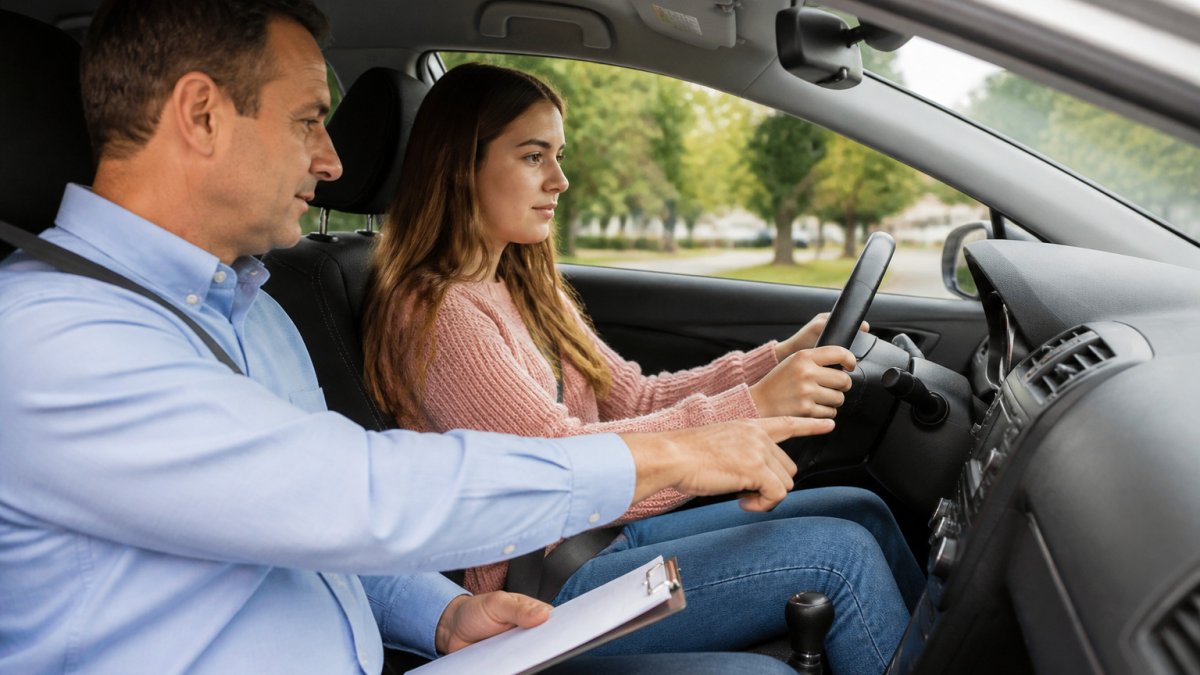
Behind-the-wheel training with a licensed instructor provides personalized feedback in actual driving conditions. An experienced instructor watches your steering, braking, lane positioning, and decision-making, immediately correcting errors, praising good habits, and adjusting the lesson to your needs.
The advantage is accountability and real-world context: you're not hypothetically deciding what to do, you're doing it while an expert observes and guides you. This direct feedback accelerates skill development and builds genuine confidence.
The limitation is scheduling and cost. Behind-the-wheel lessons require coordination, travel, and a higher per-hour investment than online courses, so finding consistent time can be challenging for busy families.
The Combined Approach: Why Theory Plus Practice Wins
The most effective learning path combines online theory with behind-the-wheel practice. Online courses build your knowledge foundation efficiently, so your behind-the-wheel time focuses on applying knowledge rather than learning basics.
Arriving at your first lesson with a solid theoretical foundation means your instructor spends less time explaining concepts and more time coaching real-world application, so lessons become more productive and confidence builds faster.
Behind-the-wheel instruction also reveals gaps in your online learning.
Best For New drivers aged 16-22 with busy schedules or families seeking comprehensive training. The combined approach fits different learning styles and ensures both knowledge and practical skill development.
Measuring Progress and Building Confidence
How do you know if you're improving at defensive driving? Progress isn't always obvious, but small improvements accumulate into genuine skill development.
Track specific metrics: how often you maintain the three-second following distance, whether mirror checks happen automatically, and how many hazards you predict before they develop. Over several weeks, these numbers should improve noticeably.
Confidence builds differently than skill. You might be technically improving but still feel nervous, which is normal.
A practical confidence builder is progressive challenge. Don't jump from quiet neighborhood streets to rush-hour highway driving; gradually increase complexity through busier streets, higher speeds, more congested traffic, and worse weather.
Special Scenarios: Night Driving, Heavy Traffic, and Weather
Defensive driving principles apply universally, but night driving, heavy traffic, and adverse weather demand specific adjustments.
Night driving reduces visibility dramatically: headlights illuminate only 150-200 feet ahead at highway speeds, compared to 400+ feet in daylight, and depth perception becomes harder.
Heavy traffic demands patience and predictability.
Weather conditions, rain, snow, and fog, require immediate speed reduction.
According to the National Highway Traffic Safety Administration, weather conditions contribute to roughly 21 percent of all crashes.
Learning defensive driving is an investment in your safety and everyone else's on the road.
The challenge isn't finding information about defensive driving, it's finding a program that combines theory and practice effectively, fits your schedule, and gives you genuine confidence, not just test-passing ability. The result: confident, responsible drivers prepared not just to pass a test, but to stay safe for decades. Log In to explore how our program fits your learning goals.
Frequently Asked Questions
What's the best way to learn defensive driving if I'm a complete beginner?
Start with a structured 30-hour online course to build foundational knowledge of hazard recognition, reaction time, and risk assessment. Then combine that theory with behind-the-wheel instruction from a licensed educator who can provide personalized feedback on your actual driving. This two-part approach, online foundation plus hands-on practice, gives beginners both the knowledge and confidence needed for safe driving. Most learners benefit from 6-8 weeks of progressive practice with clear milestones.
How long does a defensive driving course typically take to complete?
A comprehensive defensive driving course usually takes 30-40 hours total. Online components typically require 20-30 hours of self-paced study covering hazard perception, speed management, and vehicle control principles. Behind-the-wheel instruction usually adds 6-10 hours of hands-on practice with an instructor. The total timeline depends on your schedule and learning pace, but most students complete the program within 6-12 weeks when combining online and in-car lessons.
Can I learn defensive driving entirely online, or do I need in-car lessons?
Online courses alone teach the theory, hazard recognition, road safety principles, and decision-making frameworks, but they cannot develop the muscle memory and real-world judgment that behind-the-wheel instruction provides. An online defensive driving course online gives you the foundation, but actual driving practice with an instructor is essential to build confidence, learn vehicle control, and practice reacting to real hazards. The combination of both is the most effective way to learn.
What defensive driving techniques should I focus on as a beginner?
Master these core defensive driving techniques first: maintain a safe following distance (3-4 seconds behind the car ahead), scan ahead constantly for hazards, anticipate other drivers' actions, adjust speed for road and weather conditions, and identify escape routes before entering risky situations. Practice these fundamentals in low-traffic environments first, then gradually apply them in busier, more complex driving scenarios as your confidence grows.
How can I measure whether I'm improving in defensive driving?
Track progress by noting your reaction time improvements, ability to spot hazards earlier, smoother lane changes, and reduced braking incidents. Many structured programs include performance reviews after each lesson, and optional video review tools let you see your own driving and identify areas to refine. You'll also notice increased confidence in heavy traffic, night driving, and adverse weather, these real-world improvements are reliable signs of progress.
Is defensive driving training different for teenagers versus adults who are learning to drive later?
The core defensive driving techniques are the same, but the learning approach differs. Teenagers benefit from longer practice periods to build habit formation, while adults often learn faster due to life experience but may need extra practice with vehicle-specific skills. A personalized program adjusts pacing and focus areas based on your age, experience level, and confidence. Both groups benefit equally from combining online instruction with hands-on practice.
Log In


Comments