Customized Driving Lessons for Busy Families
Updated: 7 days ago
Last Updated: October 25, 2026
Quick Summary
Customized driving lessons are designed around your family's schedule and your learner's specific needs, not a one-size-fits-all curriculum. Students progress faster, gain genuine confidence, and arrive at their road test genuinely prepared because instruction matches their learning pace and addresses their actual starting point.
Flexible scheduling and pickup and drop-off service eliminate logistical stress for busy families juggling multiple commitments.
Online driver education courses teach rules and concepts while behind-the-wheel training builds real-world skills and decision-making ability.
The instructor assesses your learner's starting point, anxiety level, and learning style to build a personalized lesson plan that adapts as they progress.
Table of Contents
Why Customized Driving Lessons Matter for Busy Families
Flexible Driving Lesson Schedules That Fit Your Life
Driving Lessons With Pickup and Drop-Off Service
How Many Driving Lessons Do Beginners Need
Combining Online Driver Education Course With Behind-the-Wheel Training
Customizing Your Lesson Plan to Your Learner's Needs
Assessing Your Teen or Adult Driver's Starting Point
Adjusting Instruction Based on Progress and Confidence
Parent Involvement and At-Home Practice Between Lessons
Getting Your Student Road-Test Ready
Frequently Asked Questions
Why Customized Driving Lessons Matter for Busy Families
Customized driving lessons are designed around your family's actual schedule and your learner's specific needs, not a one-size-fits-all curriculum. The difference shows up immediately: students progress faster, gain genuine confidence, and arrive at their road test genuinely prepared.
Most families face the same constraint: time. Between school, work, and other commitments, fitting driver education into a rigid schedule feels impossible. That's where customization changes everything. Instead of forcing your teen into a class that meets at fixed times, you build a program that works with your life.
At Pfister Auto Academy, we understand that the families who succeed aren't the ones with the most free time, they're the ones whose driving lessons adapt to their reality. A student whose instruction matches their learning pace and personality gains confidence faster.
The real value isn't convenience alone. It's that customized instruction addresses what generic programs miss: your learner's actual starting point, their anxiety level, the specific road conditions they'll face, and the gaps between online theory and real-world driving.
Flexible Driving Lesson Schedules That Fit Your Life
Scheduling driving lessons shouldn't require juggling your entire family's calendar. Flexible driving lesson schedules mean you book lessons when they work, not when a class calendar says they're available.
Many families discover that back-to-back rigid schedules create stress, not learning. Your teen is exhausted after school. Your work schedule shifts. A weekend lesson gets bumped by a family event.
Here's what matters most: consistency without rigidity. Your learner benefits from regular practice, but that practice should land when your teen is alert and you're available to support them. Some families prefer weekday afternoons right after school.
The practical benefit: when a lesson fits naturally into your schedule, your teen shows up ready to focus. They're not rushed. You're not stressed about transportation or timing.
You can explore customized lesson packages that align with your family's needs at Pfister Auto Academy through our flexible scheduling options. Check current availability and pricing to find the schedule that fits your situation.
Driving Lessons With Pickup and Drop-Off Service
Door-to-door service eliminates one of the biggest friction points for busy families: the logistics of getting your learner to and from lessons.
Driving lessons with pickup and drop-off mean your student doesn't need a ride from you, the instructor handles transportation. For families juggling multiple kids, work schedules, or limited flexibility, this changes everything. You don't coordinate pickups.
The real efficiency gain isn't just time saved. It's mental load removed. You're not managing another appointment detail.

For families with multiple kids, this matters even more. While one child is in a lesson, you're not tied up managing transportation for another.
The vehicle itself matters too. Practicing in a safe, reliable car gives your teen and your family peace of mind.
How Many Driving Lessons Do Beginners Need
There's no universal answer, but there are clear patterns. How many driving lessons do beginners need depends on starting point, learning pace, and local road complexity.
Most novice drivers benefit from professional instruction combined with supervised practice at home. That's a range, not a guarantee. A learner who picks up skills quickly and practices consistently between lessons might reach road-test readiness faster. Another student might need more hours plus substantial at-home practice.
The actual variable isn't just time, it's quality of instruction and consistency of practice. Ten hours with an experienced instructor who tailors each session to your learner's needs often produces good results. The instructor identifies what your teen struggles with, focuses on those specific skills, and adjusts the difficulty based on progress.
Here's the practical framework:
Stage | Hours | Focus | Readiness Signal |
Foundation | 4-6 hours | Basic controls, smooth acceleration, stopping | Comfortable in low-traffic areas |
Intermediate | 4-6 hours | Turns, lane changes, moderate traffic | Handles familiar roads independently |
Advanced | 3-6 hours | Highway driving, complex intersections, decision-making | Confident in varied conditions |
Road-test prep | 2-3 hours | Test route specifics, test-day procedures | Passes practice test |
Between professional lessons, at-home practice with a parent matters significantly. A learner who practices 2-3 times weekly between lessons progresses faster than one who only gets formal instruction. The practice reinforces skills and builds the muscle memory that makes driving automatic. In Indiana, all learners must obtain 50 hrs of driving, 10 of which must be at night. While we show students what to do, when to do it, how to do it and why, all new drivers must practice those new skills. Imagine watching how the quadratic formula is used in algebra and then never doing homework and expecting to pass the test. If we were realistic, many of us don’t know where to start anymore and we all learned it at some point. Driving is no different, except it’s a skill utilized more by the general masses. Practice is always essential!
Combining Online Driver Education Course With Behind-the-Wheel Training
Theory and practice work together, not separately. The online driver education course teaches the rules and concepts. Behind-the-wheel training teaches the skills and judgment.
An online course alone doesn't make a safe driver. Your learner can pass the written test without ever turning a steering wheel.
Behind-the-wheel instruction alone skips critical knowledge. Your teen might handle a car well but not understand right-of-way rules, speed limits in different zones, or what to do at an unmarked intersection.
The combination works because each fills gaps the other can't. The online course builds knowledge. Behind-the-wheel training builds skill and confidence.
The practical sequence: complete the online course first, or work through it concurrently with early lessons. The instructor sees what your teen learned in the course and builds on it.
This integrated approach also means your learner isn't wasting lesson time on basics they already know from the course. Every behind-the-wheel hour focuses on skills and decision-making, not remedial knowledge.
Customizing Your Lesson Plan to Your Learner's Needs
Generic lesson plans assume all learners start from the same place with the same strengths and weaknesses. They don't.
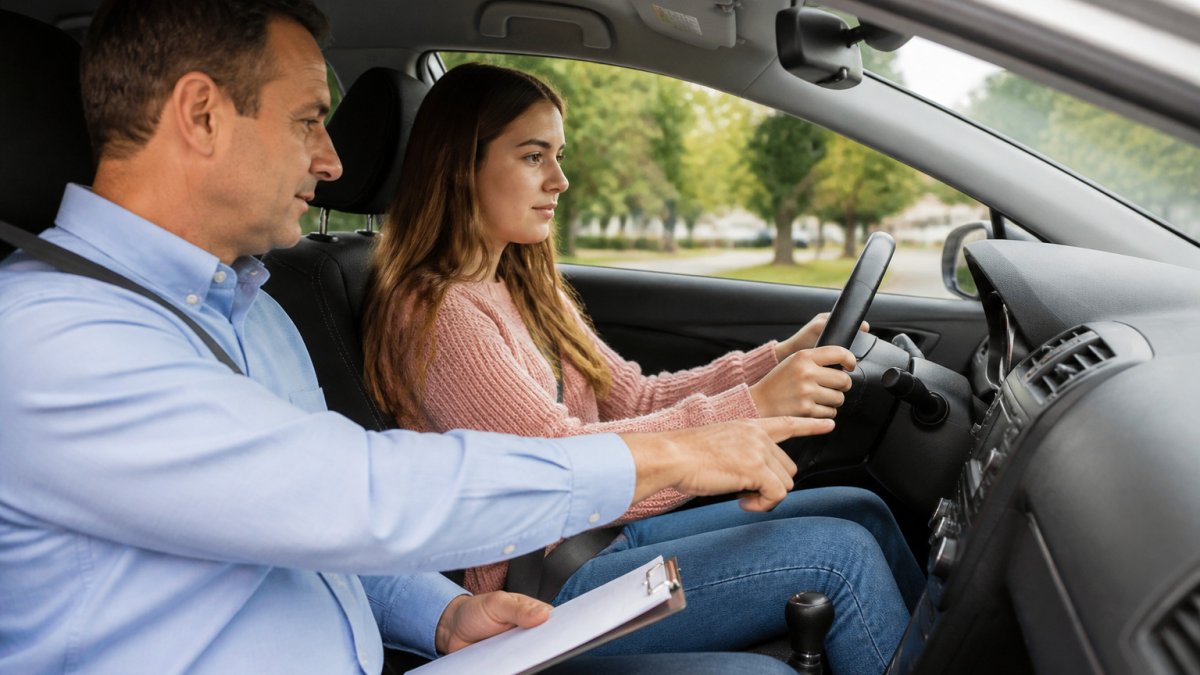
Customized driving lessons mean the instructor assesses your learner, identifies specific needs, and builds a plan around them. One teen might be confident with basic driving but anxious about highway merging. Another might handle complex traffic well but struggle with parallel parking. A third might be physically smaller and need seat and mirror adjustments that affect visibility and control.
The instructor's role includes diagnosis before prescription. What specific skills does your learner need most? Where is their confidence already strong? What roads or situations trigger anxiety? What's their learning style, do they absorb information through explanation, demonstration, or hands-on practice?
Assessing Your Teen or Adult Driver's Starting Point
The first lesson is about assessment. Really the first 5 minutes is ththe first drive is about assessment. The instructor observes how your learner responds to the vehicle, whether they're comfortable with controls, what their anxiety level is, and what they already know.
A teen might have strong hand-eye coordination but no understanding of real-world consequences. An adult learner who delayed getting their license might have more life experience and patience but less physical familiarity with vehicle controls. A nervous student might need slower progression and more explanation. A confident student might be ready to push into more challenging scenarios faster.
The assessment shapes everything that follows. If your learner is anxious, early lessons focus on building comfort in low-traffic areas. If they're overconfident, lessons include scenarios that teach respect for real hazards. If they have specific fears, highway driving, night driving, parking, those get addressed strategically, not avoided.
Adjusting Instruction Based on Progress and Confidence
The lesson plan isn't fixed. It adapts as your learner progresses.
After the first few lessons, the instructor has clear data about what's working. Your teen might master smooth acceleration quickly but struggle with smooth braking. They might handle turns confidently but hesitate at four-way stops.
Customized instruction means the next lesson adjusts. If smooth braking is the issue, that gets focused practice. If four-way stops create confusion, the instructor finds multiple examples and walks through the decision-making process. If night driving triggers anxiety, lessons gradually build that skill with increasing complexity.
Progress also means increasing difficulty. Once your learner handles quiet residential streets confidently, lessons move to busier roads. Once they manage moderate traffic, highway driving gets introduced.
Confidence builds through success, not pressure. The instructor knows when your learner is ready to advance and when they need more practice at their current level. Pushing too fast creates anxiety. Staying too long at one level creates boredom.
Parent Involvement and At-Home Practice Between Lessons
Professional lessons teach skills. At-home practice builds them into automatic responses.
Your involvement between lessons matters. A learner who practices with a parent progresses faster than one who only gets formal instruction. The practice reinforces what the instructor taught and builds confidence in varied situations.
At-home practice doesn't mean driving aggressively or testing limits. It means supervised driving in real conditions your teen will actually face.
Here's what works: start with the roads and conditions where your learner feels most confident. Drive the same route multiple times so they develop familiarity. Gradually introduce new roads, busier traffic, or different times of day.
Your role is observation and calm guidance, not instruction. You're not teaching driving. You're providing safe practice space. If your teen makes a mistake, you don't overcorrect or create panic.
Getting Your Student Road-Test Ready
Road-test readiness isn't about memorizing test routes. It's about genuine skill and confidence across varied conditions.
Your learner is ready when they can handle the roads and situations they'll actually encounter, not just the test route. They understand right-of-way and traffic laws. They can make smooth, confident maneuvers. They respond calmly to unexpected situations.
The final lessons focus on test-specific skills: parallel parking, three-point turns, and the specific maneuvers the test requires. But those are just applications of skills already learned.
On test day, your teen shouldn't feel like they're being tested on something unfamiliar. They should feel like they're doing something they've practiced many times.
Customized driving lessons remove the friction that stops families from getting professional instruction. When lessons fit your schedule, adapt to your learner's pace, and include convenient pickup and drop-off service, driver education becomes something that actually works for your life.
Frequently Asked Questions
Can driving lessons be scheduled around a busy family's routine?
Yes. Customized driving lessons are designed specifically for families juggling work, school, sports, and other commitments. Professional instructors offer evening and weekend availability, as well as flexible session lengths, from 60-minute focused lessons to 90-minute or two-hour sessions, so you can choose what fits your calendar. Many instructors also provide door-to-door pickup and drop-off, eliminating the need for a parent to drive separately, which saves significant time for busy households.
How many driving lessons do beginners need to feel confident?
Most beginner drivers benefit from professional behind-the-wheel lessons, though the exact number depends on the individual's prior experience, natural ability, and learning pace. A comprehensive program that combines a 30-hour online driver education course with personalized in-car instruction can help accelerate progress. Your instructor will assess your learner's skills during early lessons and recommend a customized plan that addresses specific weak areas, ensuring you invest in the instruction your student actually needs rather than a one-size-fits-all package.
Are online driver education courses available alongside behind-the-wheel lessons?
Absolutely. Many professional driving academies combine a 30-hour online driver education course, covering traffic laws, hazard recognition, and defensive driving, with hands-on instruction in the vehicle. This hybrid approach allows your student to absorb theory at their own pace, anywhere, anytime, while the instructor focuses behind-the-wheel sessions on practical skills and real-world decision-making. The online component often includes analytics that help the instructor personalize each in-car lesson to address gaps identified in the coursework.
What should parents look for in a customized driving lesson program?
Prioritize an instructor with a master educator credential and significant professional experience. Verify the program includes both online classroom material and hands-on instruction, a well-maintained, safe vehicle for training, and flexible scheduling that genuinely accommodates your family's calendar. Confirm the program addresses your learner's specific concerns, whether that's highway anxiety, night driving, or test-day nerves, through tailored lesson plans rather than a rigid curriculum. Ask about progress tracking and whether the instructor can conduct your official driving test.
Log In
Add pfisterautoacademy.com as a preferred source on Google →


Comments