How to Pass Road Test Easily: 2026 Driver's Guide
Table of Contents
How to Pass Road Test Easily: What the Examiner Actually Scores
The Five Scoring Categories Behind Every Road Test
Automatic Fails vs. Point Deductions
Road Test Checklist: What to Bring and How to Prep Your Vehicle
Driving Test Tips: Master the Maneuvers Examiners Score
Parallel Parking, Three-Point Turns, and Straight-Line Backing
Lane Changes, Mirror Checks, and Blind Spots
How Many Driving Lessons Before a Road Test? A Practice Plan for Every Timeline
If You Have Four or More Weeks
If You Have One Week
If You Have One Day
If You Have Only a Few Hours
What to Practice First, Regardless of Timeline
Common Road Test Mistakes That Fail First-Time Drivers
What Happens During the Appointment and How to Recover From a Mistake
Step 1: Check-In
Step 2: Vehicle Inspection
Step 3: Pre-Drive Instructions
Step 4: The Drive
Step 5: The Result
Recoverable Mistakes vs. Disqualifying Mistakes
How to Recover in the Moment
Frequently Asked Questions
Last Updated: October 15, 2026
How to Pass Road Test Easily: What the Examiner Actually Scores
Wondering how to pass road test easily? The answer starts with understanding that the road test is not a mystery.
Most first-time drivers fail for small, fixable reasons. A missed mirror check. A slow reaction at a stop sign.
The good news: habits can be built. Below, we'll show you exactly how to prepare, what to practice, and what happens on test day.
The Five Scoring Categories Behind Every Road Test
Every road test scores five core areas. Knowing them changes how you practice.
Observation - Do you check mirrors and blind spots before moving?
Vehicle control - Steering, braking, and acceleration smoothness
Maneuvers - Parking, turns, and backing up
Traffic rules - Signs, signals, right-of-way, speed limits
Judgment - Following distance, lane position, and safe decisions
Each category carries weight. Weakness in one drags down your score.
Automatic Fails vs. Point Deductions
Some mistakes end the test instantly. Others just cost points.
Automatic failures include:
Hitting a curb or cone during a maneuver
Running a red light or stop sign
Failing to yield the right-of-way
Needing examiner intervention to avoid a crash
Point deductions are smaller. Missing a mirror check, drifting in your lane, or braking too hard each cost points. Stack enough of them and you still fail.
Watch Out The most common automatic failure is failing to fully stop at a stop sign. Rolling stops count as running the sign. Come to a complete stop, count to two, then go.
Road Test Checklist: What to Bring and How to Prep Your Vehicle
Arriving unprepared is the easiest way to fail before you even drive. Use this checklist.
Zutobi Drivers Ed
Documents to bring:
Learner's permit or instruction permit
Proof of identity and residency
Proof of vehicle registration
Proof of insurance
Vehicle readiness:
Headlights, brake lights, and turn signals work
Tires are properly inflated
Horn works
Mirrors are clean and adjusted
Pro Tip Adjust your seat, mirrors, and steering wheel before the examiner gets in. Fumbling with controls after the test starts signals you're not ready. Do it in the first 30 seconds.
Driving Test Tips: Master the Maneuvers Examiners Score
Practice these maneuvers until they feel automatic. That's how you pass road test without panic.

Parallel Parking, Three-Point Turns, and Straight-Line Backing
Parallel parking trips up more drivers than anything else. The steps:
Pull alongside the front car, about two feet away
Check mirrors and blind spot
Reverse slowly, turning the wheel toward the curb
Straighten once you're at a 45-degree angle
Turn the wheel the other way and back in
Straighten out, check your spacing, set the parking brake
Three-point turns test control. Signal, check traffic, turn toward the curb, reverse while checking behind you, then turn back into the lane. Go slow.
Straight-line backing is simple but easy to rush. Turn your head and body to look behind you. Use your mirrors. Keep the wheel steady.
Lane Changes, Mirror Checks, and Blind Spots
Examiners watch your head, not just your hands. They want to see you physically check.
Before every lane change:
Check your rearview mirror
Check your side mirror
Turn your head to check the blind spot
Signal
Key Takeaway Mirror checks are the single easiest points to earn. Do them every time you move, stop, or turn. Examiners score observation heavily because it predicts safe driving.
How Many Driving Lessons Before a Road Test? A Practice Plan for Every Timeline
There is no universal number of lessons. What matters is whether you can perform every scored maneuver without prompting. Most learners reach that point somewhere between 20 and 50 hours of supervised driving, but the timeline you have left should shape how you spend it, not how many hours you log.
Use the plan below that matches your remaining time. Each session should run 30 to 45 minutes. Shorter, focused drives beat long, tiring ones.
If You Have Four or More Weeks
Week 1, Build the base. Two sessions on quiet residential streets.
Week 2, Add maneuvers. Two sessions in an empty lot.
Week 3, Add traffic. Two sessions on roads with signals, four-way stops, and lane changes.
Week 4, Mock tests only. Two full run-throughs with a quiet passenger. No coaching, no corrections mid-drive.
If You Have One Week
Day 1: 45 minutes in an empty lot on parallel parking only.
Day 2: 45 minutes on three-point turns and straight-line backing.
Day 3: 45 minutes on residential streets, full stops, signals, mirror checks.
Day 4: 45 minutes on a busier road, lane changes, following distance, speed control.
If You Have One Day
You cannot build new habits in a day, but you can sharpen the ones you have. Spend 20 minutes on parallel parking, 20 minutes on full stops and mirror checks, and 20 minutes on a mock route. Then stop. Cramming the night before makes drivers tense, and tension causes more failures than missing practice.
If You Have Only a Few Hours
Drive the exact route you expect on test day if you can find it. Focus on three things only: complete stops, mirror checks before every move, and staying at or just under the speed limit. Do not try to fix every weakness. Pick the three habits that cost the most points and drill those.
Do at least one full mock test with someone playing the examiner. Have them stay quiet and just watch. The silence is what throws most people off on the real day.
Do not schedule a marathon practice session the day before your test. Fatigue and anxiety on test day cost more points than one extra hour of practice gains.
What to Practice First, Regardless of Timeline
If you are short on time, rank your practice in this order:
Full stops at stop signs and right-turn-on-red situations
Mirror and blind-spot checks before every move
Parallel parking
Lane changes with proper signaling
Speed control
These five cover the majority of point deductions and the most common automatic failures.
Common Road Test Mistakes That Fail First-Time Drivers
The same mistakes show up again and again. Avoid these and you're ahead of most drivers.
Rolling stops - Come to a full stop. Always.
Forgetting turn signals - Signal every turn and lane change, even when alone.
Not checking blind spots - Turn your head, don't just glance.
Driving too fast or too slow - Match the speed limit but stay cautious.
Panicking after a mistake - One error doesn't fail you. Keep driving.
Poor lane position - Stay centered, not hugging one side.
Following too closely - Keep a safe distance from the car ahead.
What Happens During the Appointment and How to Recover From a Mistake
Most of the anxiety around the road test comes from not knowing what the next 30 minutes will look like. Here is the actual sequence, step by step, so nothing catches you off guard.
Step 1: Check-In
You arrive at the testing location, join the line or check in at the counter, and present your documents. The clerk verifies your identity, permit, registration, and insurance. If anything is missing or expired, the test is cancelled before it starts. This is the single most preventable failure.
Step 2: Vehicle Inspection
Before you drive, the examiner walks around your car. They check that headlights, brake lights, turn signals, and the horn work. They look at tire condition and confirm the registration and insurance match the vehicle. Some examiners ask you to demonstrate the horn, wipers, or defroster. Know where every control is without hunting for it.
Step 3: Pre-Drive Instructions
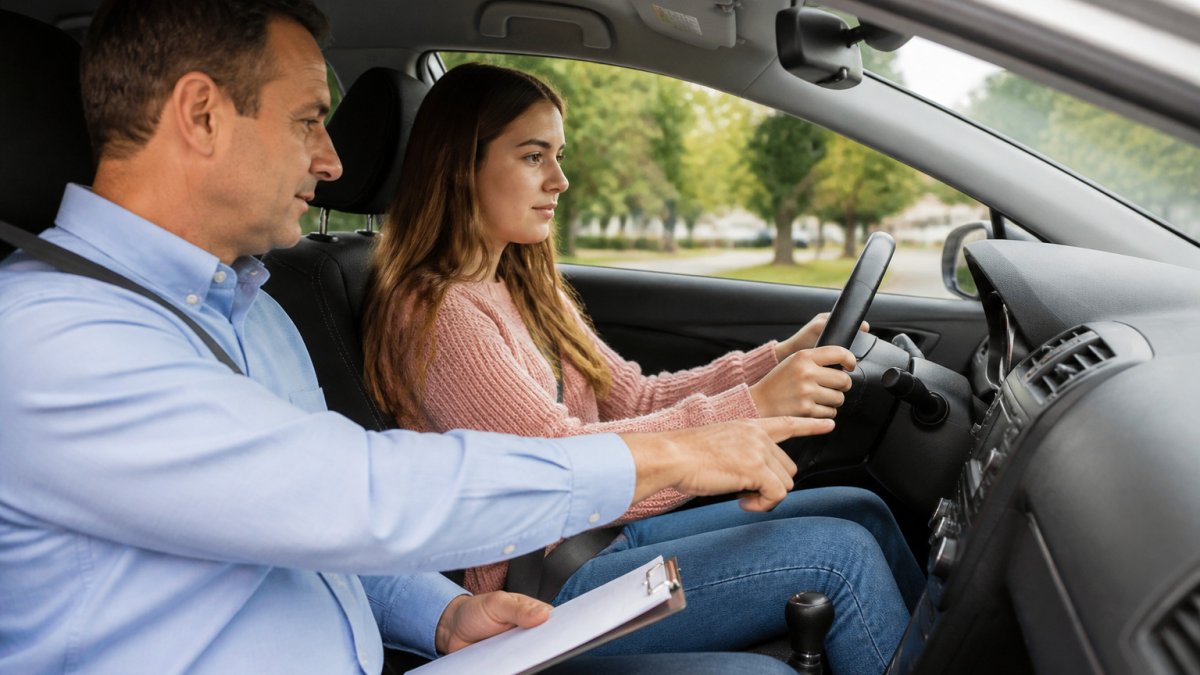
You get in, the examiner gets in, and they explain what they will ask you to do. They may ask you to adjust your seat, mirrors, and steering wheel now. Do it. Then buckle up, and confirm the examiner is buckled before you start the engine.
Step 4: The Drive
The examiner gives directions, 'turn left at the next street,' 'pull over and park here,' 'back up in a straight line.' You drive a route that covers the scored maneuvers: intersections, lane changes, parking, turns, and speed control. The drive usually runs 15 to 30 minutes depending on the route and local requirements.
Step 5: The Result
You return to the starting point. The examiner tells you whether you passed, and if you did not, they walk you through the deductions. In many states you receive a scored sheet showing exactly where points were lost. Keep it. It is your practice plan for the retest.
Recoverable Mistakes vs. Disqualifying Mistakes
Not every error ends the test. Knowing the difference is what keeps you calm behind the wheel.
Recoverable mistakes, keep driving, do not apologize, do not stop:
Missing a mirror check once
Drifting slightly in your lane and correcting
Braking a little harder than needed
Taking a turn slightly wide
Disqualifying mistakes, the examiner may end the test immediately:
Hitting a curb or cone during a scored maneuver
Running a stop sign or red light
Failing to yield the right of way
Requiring the examiner to grab the wheel or brake to avoid a crash
Freezing after a mistake is worse than the mistake itself. If you miss a turn or bump a curb, take a breath, check your mirrors, and continue. Panic causes more failures than skill gaps.
How to Recover in the Moment
If you make a recoverable error, run this sequence:
Take one slow breath.
Check your mirrors.
Return to the correct speed and lane position.
Continue driving as if nothing happened.
Do not narrate the mistake, do not apologize, and do not ask the examiner how you did. They are not allowed to coach you mid-test, and asking only adds pressure.
The road test rewards steady, predictable driving more than perfect driving. One small error will not fail you. A panic spiral after that error will.
Pfister Auto Academy includes the official driving test with your instructor, so there's no BMV appointment to schedule and no unfamiliar examiner in the passenger seat.
Frequently Asked Questions
What is the number one reason for failing a driving test?
Inadequate observation is the most common reason. Examiners watch whether you check mirrors, turn your head to clear blind spots, and look over your shoulder before backing. Missing these checks during lane changes, turns, or parking leads to point deductions or an automatic failure. Practice narrating your observations out loud so they become automatic: mirror, signal, blind spot, then move.
Is 20 driving lessons enough to pass a road test?
Twenty lessons is a solid benchmark for many new drivers, but readiness matters more than the number. If you can complete parking, three-point turns, and lane changes without prompting, you are likely ready. If you still need reminders for mirror checks or speed control, add a few more sessions. A structured practice plan with a mock test will tell you more than counting hours.
How do you perform a three-point turn on a road test?
Signal, check mirrors and blind spots, then pull to the right edge. Turn the wheel hard left and creep forward until you are near the opposite curb. Stop, shift to reverse, check mirrors and blind spot again, turn the wheel hard right, and back up slowly. Shift to drive, turn left, and straighten out. Keep movements smooth and scan for traffic at every step.
How can you calm your nerves before a driving test?
Arrive early, take slow deep breaths, and remind yourself that you have practiced these exact maneuvers. Wear comfortable shoes, avoid caffeine, and get a full night's sleep. During the test, talk yourself through each step. If you make a small error, keep driving safely; one mistake does not mean failure. A short walk or stretch before the appointment helps release tension.
Passing your road test comes down to preparation, not luck. The drivers who pass on the first try are the ones who practiced the right habits until they became automatic. Pfister Auto Academy makes that easier with a 30-hour online course, personalized behind-the-wheel training in a 2025 Toyota Camry, and the official test included with your instructor, no BMV wait required. Get started with Pfister Auto Academy and walk into your test already knowing you're ready.
Log In


Comments